
Why English Language Proficiency Shapes Your Career Path
In today’s global job market, your technical skills alone rarely determine how far you go. The way you communicate, present ideas, and connect with colleagues and clients plays an equally important role. English has become the default language of international business, and its influence on career development is hard to ignore.
A 2023 report by the British Council found that over 1.75 billion people use English globally for professional purposes. Employers in sectors ranging from technology to healthcare consistently rank English communication as one of the top skills they look for during hiring. This is not just about sounding fluent. It is about being able to express ideas clearly, write professionally, and participate meaningfully in high-stakes conversations.

Whether you are just entering the workforce or aiming for a leadership role, improving your English language skills can directly expand your career opportunities. This article explores how English proficiency influences career growth, what industries value it most, and practical ways to build it effectively.
The Direct Link Between English Proficiency and Career Advancement
Companies operating across borders need employees who can work without language barriers. This demand has pushed English from a desirable trait to a near-essential qualification in many roles. Research from EF Education First’s English Proficiency Index consistently shows that countries and companies with higher English proficiency generate stronger economic outputs and offer better-paying jobs.
From a personal career standpoint, professionals with strong English skills tend to get promoted faster, earn more, and gain access to international assignments. A study published in Harvard Business Review found that non-native English speakers who improved their business writing and communication skills saw measurable increases in career mobility within two years.

The connection is especially visible in performance reviews. Managers evaluate not just what you deliver, but how you explain it. Employees who articulate their contributions clearly are perceived as more capable, even when their technical output is comparable to peers.
English Proficiency Impact Across Key Industries
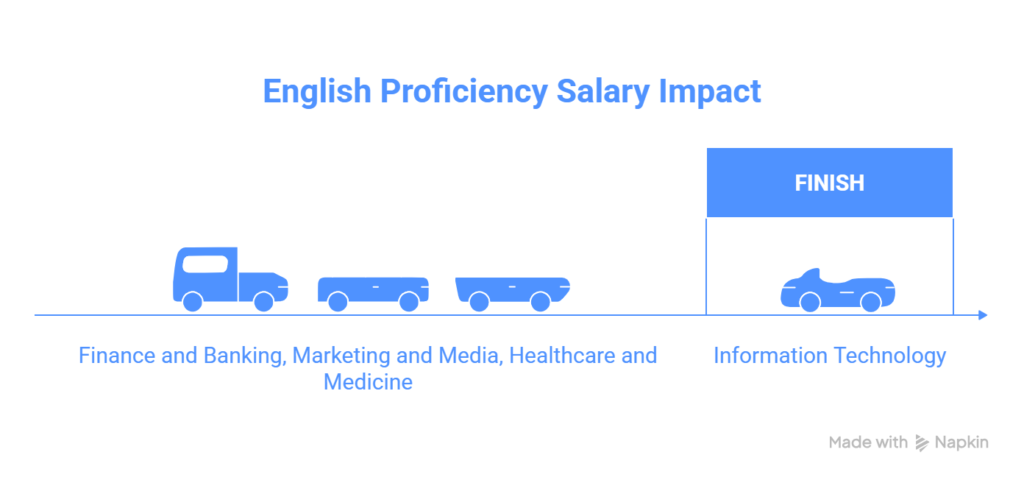
The table below summarizes how English language skills affect career outcomes across major professional sectors.
| Industry Sector | English Proficiency Impact | Avg Salary Premium |
| Information Technology | Essential for global collaboration and documentation | 25–35% |
| Finance and Banking | Required for client reports and international deals | 20–30% |
| Healthcare and Medicine | Critical for research and cross-border communication | 15–25% |
| Marketing and Media | Core skill for content creation and branding | 20–28% |
| Education and Training | Necessary for curriculum delivery and academic writing | 18–22% |
Source: Compiled from EF EPI 2023, LinkedIn Workforce Report 2023, and Glassdoor Salary Data.
How English Skills Improve Workplace Communication
Workplace communication covers a wide range of activities. Writing emails, preparing reports, giving presentations, negotiating contracts, and joining team discussions all require a reasonable command of English in multinational environments. When your language skills are strong, these tasks become less stressful and more effective.
Written Communication
Professional emails and reports set the tone for how colleagues and clients perceive you. Poor writing creates confusion and can damage trust. Strong business writing, on the other hand, builds your credibility. Professionals who write clearly tend to advance into management roles more quickly because their work is easier to understand and act on.
Verbal Communication and Meetings
Participating in meetings, especially virtual ones with international teams, requires confidence and clarity. People who can express their views concisely and respond thoughtfully to questions are more likely to be taken seriously as contributors. English fluency in spoken form also reduces miscommunication, which directly affects project outcomes and team relationships.
Cross-Cultural Collaboration
Many organizations today have teams spread across continents. English serves as the shared medium that allows these teams to function. Professionals who can navigate cultural nuance while communicating in English become valuable connectors within their organizations. This skill is particularly important for roles in project management, business development, and client services.
Real-World Examples of English Driving Career Growth
Consider the experience of a software engineer working in Dhaka who wanted to transition into a senior role at a multinational firm. His coding skills were strong, but his limited English writing ability held him back from leading documentation projects and client calls. After six months of focused English practice, specifically on business writing and presentation skills, he was promoted and assigned to a cross-border project team.
This pattern repeats across industries. A nurse in the Philippines who passed an English proficiency exam was able to move into an international healthcare placement with a 40 percent salary increase. A finance analyst in Brazil who took formal business English training was able to take on reporting responsibilities for global stakeholders, a shift that opened the door to a regional management role.
These are not exceptional cases. They reflect a consistent trend seen in workforce data worldwide. English proficiency acts as a career multiplier, especially when combined with strong technical expertise.
English Language Skills Most Valued by Employers
Hiring managers and HR professionals frequently highlight specific English skills that matter most in professional settings. These are not about accent or native-level fluency. They are about practical communication competence.
- Business writing skills, including emails, proposals, and technical documentation
- Active listening in English, particularly during meetings and interviews
- Presentation and public speaking skills in English
- Reading comprehension for technical reports, legal documents, and industry publications
- Negotiation and persuasion language for sales, partnerships, and leadership
A LinkedIn Talent Solutions report from 2023 ranked English communication as the second most requested soft skill globally, just behind critical thinking. This ranking remained consistent across North America, Asia Pacific, and the Middle East, showing that the demand for English in professional settings is not limited to any one region.
Practical Ways to Build English Skills for Career Development
Improving your English for career purposes does not require moving to an English-speaking country or enrolling in a full-time degree program. Targeted, consistent practice in relevant contexts delivers strong results over time.
Focus on Professional English, Not General English
General language learning platforms build foundational skills, but career growth requires professional English. This means learning vocabulary specific to your industry, practicing writing formats common in your field, and listening to presentations or podcasts from your sector. The more relevant your practice material, the faster it transfers to your work.
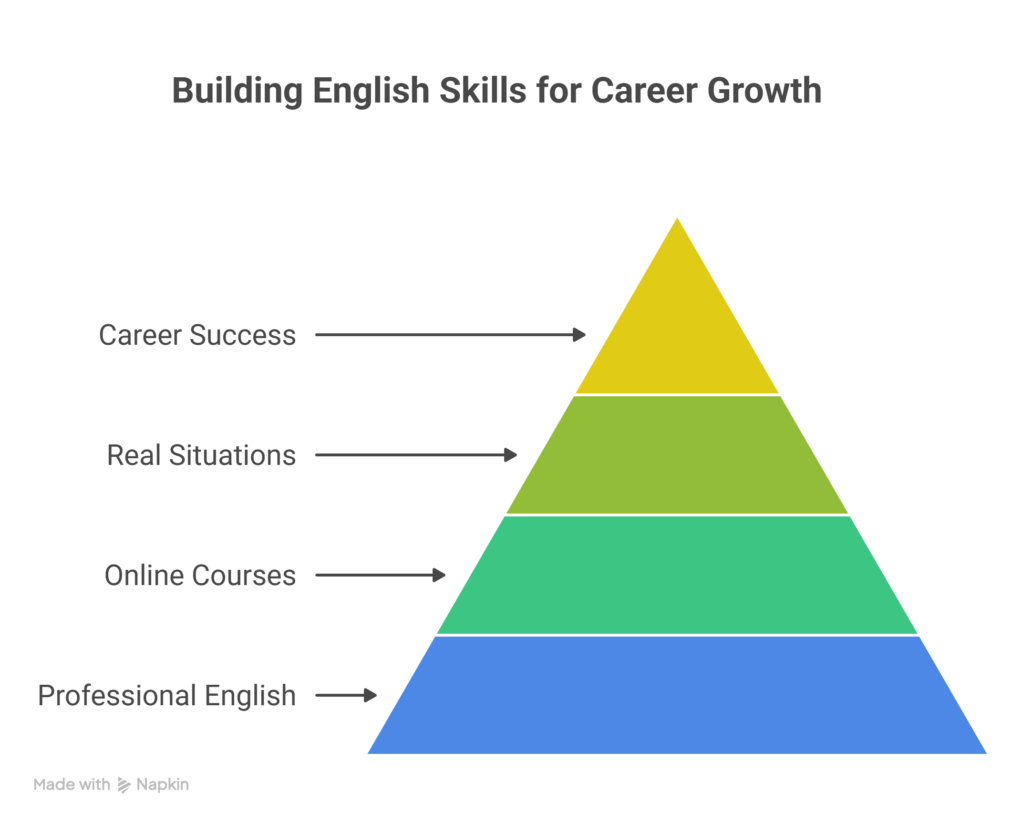
Take Online Courses and Certifications
Programs like Business English certificates from Cambridge Assessment English or Coursera’s professional communication courses give you structured learning with recognized credentials. These certificates signal to employers that you have invested in formal language development, which carries weight during hiring and promotion decisions.
Practice Through Real Situations
Nothing builds skill faster than practice in real professional contexts. Volunteering to write team reports, leading a meeting section in English, or presenting findings to a mixed-language group all accelerate growth. Making mistakes in low-stakes situations builds the confidence needed for high-stakes ones.
Expert Perspective
David Crystal, a widely cited linguist and author of English as a Global Language, has noted that fluency in English does not guarantee career success, but the absence of it increasingly limits career options. This view aligns with what workplace research consistently shows. English is not the only factor, but it is one of the few skills that touches nearly every aspect of professional life.
The Long-Term Career Value of English Proficiency
Looking beyond the immediate job market, English proficiency has compounding returns over a career. Early in your career, it helps you land roles and make a strong first impression. Mid-career, it enables leadership opportunities, international assignments, and cross-functional visibility. At senior levels, it is often a prerequisite for executive communication, board-level engagement, and industry representation.
Professionals who invest in their English skills early also benefit from a wider professional network. International conferences, online communities, global publications, and leadership programs all operate primarily in English. Being able to participate fully in these spaces creates relationships and learning opportunities that would otherwise remain inaccessible.
The return on this investment is measurable. According to EF’s own analysis, workers with high English proficiency earn between 25 and 50 percent more than counterparts in the same roles with lower proficiency, depending on the country and sector. Over a 30-year career, that difference compounds significantly.
Explore More on Career and Language Development
If you found this discussion valuable, consider reading related articles on professional communication strategies, resume writing for international job applications, and building a global career mindset. Understanding how language, skills, and positioning work together gives you a more complete picture of what drives long-term career success.
Recommended External Resources
- EF English Proficiency Index 2023 at ef.com/epi provides country-by-country data on English proficiency and its economic impact.
- British Council research on English for employability at britishcouncil.org offers reports and tools for professionals building language skills in the workplace.
Final Thoughts on English Language in Career Development
The importance of English language in career development is not a soft opinion. It is backed by hiring data, salary research, and the lived experiences of professionals across every major industry. English opens doors that stay closed otherwise, and it does so in ways that compound over time.
Building strong English skills is an investment that pays back through better opportunities, higher earnings, stronger professional relationships, and the confidence to pursue roles that were previously out of reach. Start with where you are, focus on the contexts that matter most for your work, and treat language development as a long-term professional priority rather than a one-time task.
The professionals who grow the furthest are rarely the most technically gifted. They are the ones who communicate their ideas with clarity, connect with people across boundaries, and present themselves with confidence. English, used well, makes all of that possible.