No products in the cart.


Many test-takers spend months preparing for IELTS, yet still fall short of their target band score. In most cases, the gap between preparation and performance comes down to a small set of recurring English mistakes. These are not random errors. They follow clear patterns, and IELTS examiners are trained to notice every one of them.
According to the British Council, over 3.5 million IELTS tests are taken globally each year. Of those, a significant number of candidates score below Band 7 not because of limited knowledge, but because of avoidable errors in grammar, vocabulary, and coherence. The good news is that each of these mistakes can be identified, understood, and corrected.
This guide walks you through the 10 most common IELTS mistakes in English, explains why examiners penalise them, and shows you how to fix each one before test day. Whether you are targeting Band 6.5 or pushing for Band 8, this breakdown will help you protect your score.
The table below summarises each mistake, its impact on your score, and the skill area most affected.
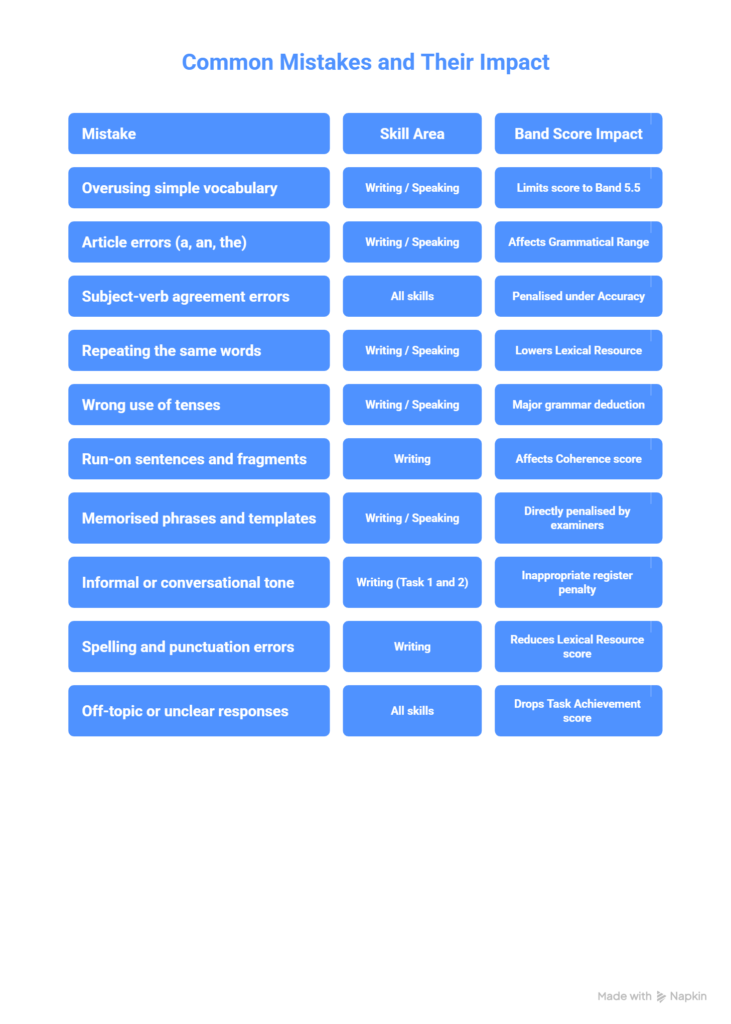
Many candidates default to basic words like “good”, “bad”, “big”, or “important” throughout their responses. While these words are grammatically correct, they signal a limited lexical range to the examiner. IELTS rewards candidates who can use a variety of words with precision.
What examiners see: A Band 5 writer might say, “It is a good idea to help poor people.” A Band 7 writer would say, “Supporting disadvantaged communities yields measurable long-term benefits.”
How to fix it: Build a habit of replacing common adjectives and verbs with more precise alternatives. Use a thesaurus, but always check meaning in context. Learn collocations, not just isolated words.
Articles are among the most misused elements in IELTS writing. Candidates either omit them entirely or use them where they are not needed. This is especially common among speakers of languages that do not use articles, such as Hindi, Arabic, or Chinese.
Wrong: “Government should invest in education.”
Correct: “The government should invest in education.”
How to fix it: Study the three core rules. Use “a” or “an” when introducing a noun for the first time. Use “the” for specific or previously mentioned nouns. Omit articles for general plural statements such as “dogs are loyal animals”.
Subject-verb agreement mistakes are surprisingly common, even among intermediate learners. They occur when the verb does not match the subject in number or person. These errors are penalised under the Grammatical Range and Accuracy criterion, which accounts for 25% of your writing and speaking scores.
Wrong: “The number of students are increasing.”
Correct: “The number of students is increasing.”
How to fix it: Always identify the true subject before choosing a verb. Phrases like “the number of”, “a group of”, and “the quality of” take a singular verb. Expressions like “a number of” take a plural verb.
Lexical Resource is one of four IELTS writing criteria, and repetition is its biggest enemy. When a candidate uses the same noun or phrase multiple times in a paragraph, it signals limited vocabulary to the examiner, regardless of how well the argument is structured.
How to fix it: Use synonyms, pronouns, and reference words to avoid repeating key terms. For example, replace “climate change” in subsequent mentions with “this environmental crisis”, “the phenomenon”, or “it” where context is clear.
Tense consistency is a core grammatical expectation in IELTS. Many candidates mix past and present tenses within the same paragraph, or use the wrong tense entirely. In Task 1 Academic, for instance, describing historical graphs in the present tense is a common and penalised error.
Wrong: “In 2005, the sales rise sharply and reach a peak.”
Correct: “In 2005, the sales rose sharply and reached a peak.”
How to fix it: Identify the time reference before writing each sentence. Use simple past for completed actions, present perfect for events with present relevance, and present simple for general truths or habits.
Coherence and Cohesion is another 25% criteria in IELTS writing. Run-on sentences, where two or more independent clauses are joined without proper punctuation or connectors, disrupt readability. Sentence fragments, meaning incomplete thoughts, confuse the examiner.
Run-on: “Pollution is a serious problem governments must act now many people are suffering.”
Corrected: “Pollution is a serious problem. Governments must act now, as many people continue to suffer.
How to fix it: Read each sentence aloud. If you cannot pause naturally, it may be too long. Use full stops, semicolons, or appropriate conjunctions to separate ideas clearly.
This is one of the most damaging IELTS mistakes a candidate can make. IELTS examiners are explicitly trained to identify and penalise memorised phrases. Using pre-written opening lines such as “In this day and age, it is undeniable that” is a red flag that lowers your score under Lexical Resource.
A survey conducted by IDP IELTS noted that memorised language is one of the top reasons candidates fail to progress beyond Band 6. The examiner will award marks for genuine language use, not rehearsed patterns.
How to fix it: Practice responding spontaneously to a wide variety of topics. Learn structures, not scripts. Write your own introductions and conclusions based on the actual question, not a fixed template.
IELTS Writing Task 2 requires a formal, academic register. Many candidates write the way they speak, using contractions, colloquialisms, and vague expressions. This is inappropriate for the task and will lower your score under Task Achievement and Lexical Resource.
How to fix it: Before writing, remind yourself that Task 2 is similar to a university essay. Read published opinion pieces or editorials to absorb formal writing patterns.
IELTS markers do not have a separate spelling score, but spelling errors directly reduce your Lexical Resource band. A candidate who misspells high-frequency words like “government”, “environment”, or “necessary” is signalling limited control of the language.
Common errors observed: “accomodate” instead of “accommodate”, “occurence” instead of “occurrence”, “recieve” instead of “receive”.
How to fix it: Create a personal spelling list of words you consistently misspell. Practice writing them in sentences. Pay close attention to double consonants and vowel patterns in academic vocabulary.
Failing to address what the question actually asks is the most direct way to reduce your Task Achievement score. Some candidates write confidently about a topic that is adjacent to the question, but not what was asked. Others address only part of a two-part question.
Expert insight: Experienced IELTS tutors consistently report that candidates lose a full band point simply by not answering both parts of a Task 2 question. Spending 60 seconds identifying all parts of the question is never wasted time.
How to fix it: Underline the key instruction words in the question, such as “discuss”, “evaluate”, “to what extent”. Make sure every paragraph directly connects back to the question before moving on.
Many candidates assume examiners focus only on big grammatical errors. In practice, examiners evaluate four equally weighted criteria for writing and speaking. These are Task Achievement, Coherence and Cohesion, Lexical Resource, and Grammatical Range and Accuracy.
Each criterion carries 25% of the total score. This means a single type of mistake, such as poor vocabulary range, can cap your band score even if your grammar is strong. Understanding this balance is critical to targeting your preparation effectively.
According to Cambridge Assessment English, candidates who score Band 7 or above consistently demonstrate flexibility in their language use. They make occasional errors, but those errors do not impede communication. The goal is not perfection. It is controlled, accurate variety.
Research across IELTS preparation communities and published examiner reports reveals consistent patterns in how these errors translate to lower scores. Consider the following data points.
Knowing what mistakes exist is only half the battle. The other half is building a consistent habit of avoiding them. Here are field-tested strategies used by candidates who improved their scores by at least one full band.
For a deeper understanding of IELTS assessment criteria and official band descriptors, these two authoritative sources are worth reading in full.
British Council IELTS: Offers official guidance on test format, marking, and preparation strategies directly from one of IELTS’ co-owners.
Cambridge Assessment English: Provides access to sample materials, examiner commentary, and detailed band descriptor explanations.
Read – Common Mistakes That Lower Your Listening Band Score
The 10 common mistakes in English covered in this guide are not signs of a weak candidate. They are signs of an unprepared one. Every single mistake on this list is correctable with targeted practice and a clear understanding of what IELTS examiners are looking for.
Your band score improves when you move from general English practice to deliberate, mistake-aware preparation. Identify which of these errors appear most often in your own work, focus your energy there, and measure your progress with timed, marked practice tests.
A Band 7 or above is within reach for the majority of dedicated candidates. The path to it runs directly through the errors you are willing to confront and fix.





Not a member yet? Register now
Are you a member? Login now