No products in the cart.

Table completion is one of the most common question types in the IELTS Academic Reading test. Many test-takers find it manageable at first glance, but scoring Band 7 or above requires more than just reading carefully. It demands a structured approach, smart use of time, and a clear understanding of how these questions are designed.
In my experience working with IELTS candidates, the students who consistently hit Band 7+ on table completion tasks are not necessarily the fastest readers. They are the most strategic ones. They know exactly where to look, what to ignore, and how to verify their answers under time pressure.
This guide covers the most effective IELTS Reading table completion tricks, built around real test patterns and field-tested strategies. Whether you are preparing for Academic or General Training, these techniques will give you a measurable advantage on test day.
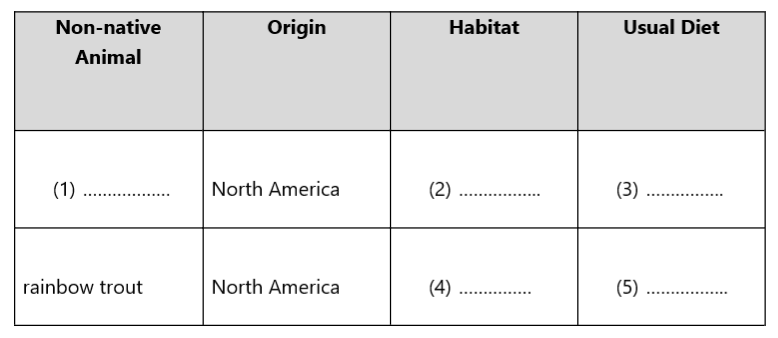
Before applying any tricks, you need to understand how the task works. In IELTS Reading table completion questions, you are given a partially filled table that summarises information from the passage. Your job is to fill in the missing cells using words directly from the text.
The most important rule to remember is the word limit. The instructions will say something like ‘NO MORE THAN TWO WORDS AND/OR A NUMBER.’ Exceeding this limit means an automatic incorrect answer, even if your content is right.
Here is what the standard format looks like across test types:
| Feature | Academic Reading | General Training Reading |
| Word limit | Usually 1-3 words | Usually 1-2 words |
| Passage type | Complex, academic | Descriptive or instructional |
| Table location | Section 2 or 3 | Section 2 or 3 |
| Answer order | Mostly sequential | Mostly sequential |
| Avg. questions | 5 to 7 per table | 4 to 6 per table |
Answers almost always appear in order within the passage, which is a significant advantage once you know how to exploit it.
One of the most powerful IELTS Reading table completion tricks is to spend 60 to 90 seconds studying the table before you even begin reading. This is not wasted time. It is an investment that saves minutes later.
When you preview the table, you get a mental map of the topic, the categories being compared, and the type of information you need. You start reading with a purpose, which dramatically speeds up your scanning process.
During your preview, focus on these four things:
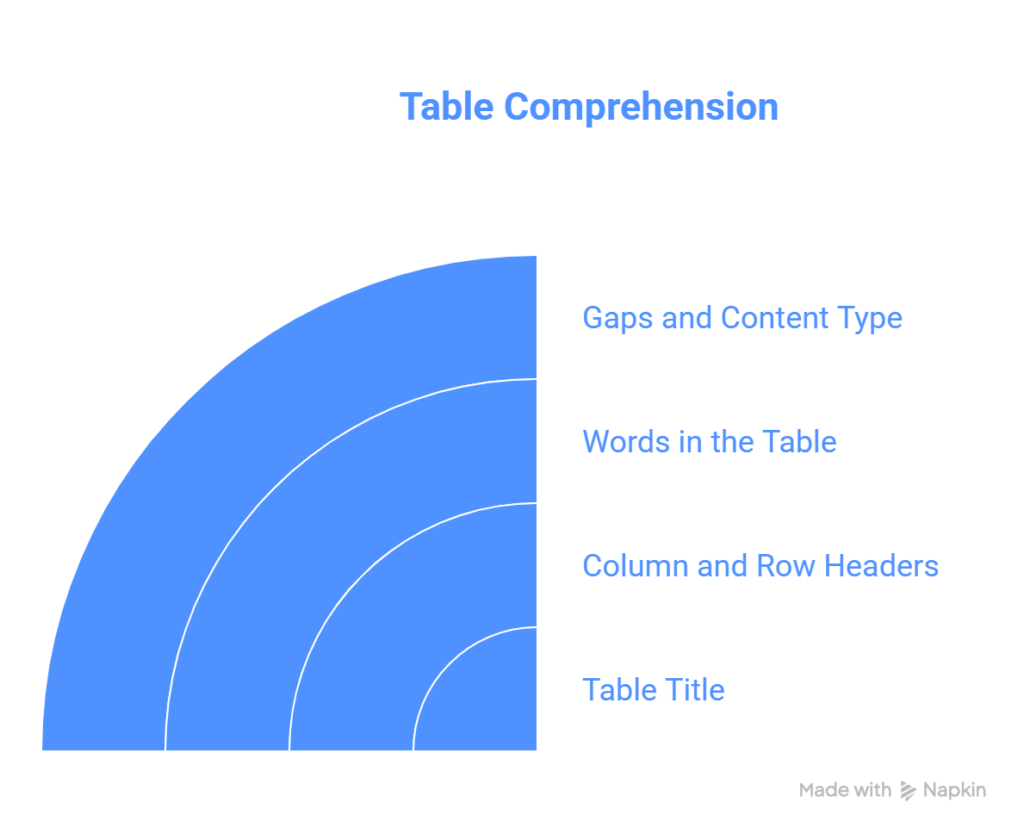
This gives you a working hypothesis for each blank before you start reading. You are not guessing. You are preparing.
Grammar is your hidden weapon in table completion. Each gap fits a specific grammatical role. If a column is labelled ‘Main Benefit’ and the other cells in that column are nouns, your answer must also be a noun. If a row uses verbs in the present tense, your answer follows the same pattern.
This eliminates many wrong options before you even find the relevant sentence in the passage. Look at the cells surrounding each blank and ask yourself: what part of speech belongs here? Is this a number, a noun phrase, an adjective, or an adverb?
A quick example: if the table shows ‘Year of establishment’ and nearby cells contain years like 1983 and 2001, your missing answer is almost certainly a four-digit year. This kind of grammar-based reasoning cuts your search time in half.
Keyword matching is the bridge between the table and the passage. Because IELTS uses paraphrasing extensively, the exact words in the table are often not the same as the words in the passage. Understanding this is critical.
Start by identifying the most specific word in the row or column near each blank. Then look for its synonym, paraphrase, or related concept in the passage. The answer will typically appear within two or three sentences of that paraphrased keyword.
Here is a practical step-by-step approach to keyword matching:
According to the British Council IELTS preparation resources, keyword recognition and paraphrase awareness are among the top skills tested in IELTS Reading. Practising these consistently can improve your score by a full band.
One reason test-takers lose time is jumping around the passage searching for answers out of order. Since table completion answers almost always follow the passage sequence, working from top to bottom, left to right, across the table is the most efficient approach.
If you cannot find an answer within 90 seconds, mark the question and move on. Do not spend three minutes on one blank at the expense of five other questions. Come back to it after you have answered the surrounding ones, which often provide context clues that unlock the missing answer.
Think of the table as a timeline moving through the passage. Each row or column you complete helps you locate the next answer faster. This momentum effect is real and worth protecting.
This is the trick that directly protects your score. In IELTS Reading table completion, you must copy words exactly as they appear in the passage. Do not rephrase, do not use synonyms, and do not correct perceived errors.
If the passage says ‘high-altitude migration’ and that fits the blank perfectly, write exactly that. If you write ‘migration at high altitude,’ you lose the mark, even though the meaning is identical. IELTS uses computerised or manual exact-match marking, and any deviation counts as wrong.
Watch out for these common copying mistakes:
Always re-read your answer against the passage text one final time before moving to the next question.
Experienced IELTS candidates use the table’s own structure to predict answers before reading a single line of the passage. This works because tables are built on parallel patterns. Each column represents one type of information, and each row represents one example or category.
Once you understand what type of information goes in a column, you can predict the answer type for every gap in that column. For example, a column labelled ‘Duration’ will only contain time expressions. A column labelled ‘Location’ will only contain place names or geographical terms.
This prediction strategy reduces your reading load. Instead of reading every sentence carefully, you are scanning with a specific target in mind. Research on test performance consistently shows that focused scanning outperforms full reading under timed conditions.
Understanding what goes wrong is just as important as knowing what works. These are the most frequent errors seen among candidates who score below Band 7 on table completion tasks:
Each of these mistakes is entirely avoidable with structured practice. Many IELTS preparation platforms, including Cambridge English, provide sample table completion tasks with annotated answers. Working through these with the above tricks in mind builds both speed and accuracy.
Here is a practical reference for understanding how accuracy on table completion tasks relates to overall Reading band scores:
| Accuracy on Table Tasks | Estimated Band Contribution | Common Skill Gap |
| 50% or below | Band 5.0 to 5.5 | Keyword recognition and word limit errors |
| 60% to 70% | Band 6.0 to 6.5 | Paraphrase awareness and time management |
| 75% to 85% | Band 7.0 to 7.5 | Exact copying and grammar prediction |
| 90% and above | Band 8.0+ | Mastery of all strategies with speed |
These benchmarks are approximate and based on typical test performance patterns. Overall Reading score depends on all question types combined, but table completion typically carries five to seven marks in a single reading section.
Knowing the tricks is not enough. You need to practise them deliberately under timed conditions until they become automatic. Here is a focused weekly practice framework for candidates targeting Band 7+:
Consistent, targeted practice over four to six weeks typically produces a visible improvement in both speed and accuracy for most candidates.
IELTS Reading table completion rewards methodical thinkers. The tricks in this guide, previewing the table, using grammar prediction, matching keywords through paraphrase, staying sequential, and copying answers exactly, work together as a system. Using even two or three of them consistently will improve your performance.
The key insight is that this question type is not about comprehension alone. It is about strategy. Test-makers design these tasks with predictable patterns, and once you understand those patterns, you can navigate them efficiently and confidently.
Start applying these techniques in your next practice session and track your accuracy on a per-question basis. Small, measurable improvements add up quickly when you are working with a structured system.
Further Reading: IELTS Band Score Requirements for Study, Work and Immigration | 10 Common Mistakes in English That Lower Your IELTS Score.





Not a member yet? Register now
Are you a member? Login now