No products in the cart.


Japan has become one of the most sought-after study destinations in the world. With a blend of world-class education, rich cultural heritage, and strong career prospects, it draws over 300,000 international students every year. If you are planning to study in Japan in 2026, this guide gives you everything you need to make the right decision.
From choosing the right university to understanding the Japan student visa process, cost of living, scholarships, and part-time work rules, this guide covers every major step in detail. Whether you are targeting a bachelor’s, master’s, or doctoral program, Japan offers a structured and rewarding academic environment for international students from all backgrounds.
Japan consistently ranks among the top countries for academic research and innovation. As of 2025, Japan has six universities listed in the QS World University Rankings Top 100. The country invests heavily in science, technology, engineering, and mathematics, making it ideal for students pursuing STEM fields.
Beyond academics, Japan offers a high quality of life with low crime rates, excellent public transportation, and a welcoming culture. The Japanese government actively supports international students through the MEXT scholarship and other funding initiatives, making education more accessible than many assume.
According to the Japan Student Services Organization (JASSO), the number of international students in Japan exceeded 340,000 in 2024. This growing trend reflects the increasing trust international students place in Japanese institutions and qualifications.
Japan has a diverse range of universities to choose from. Some are focused on research while others offer professionally oriented programs taught entirely in English. Here are the leading institutions for international students.
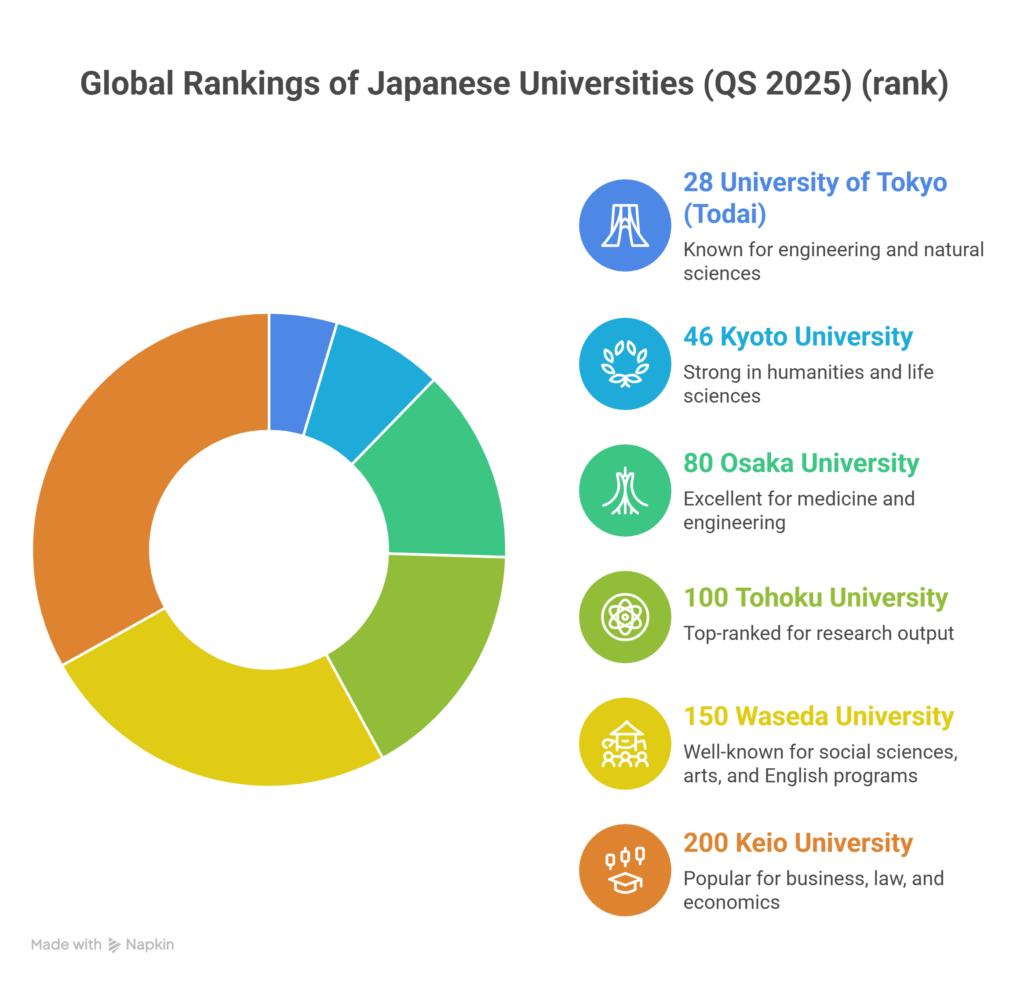
Many of these universities offer English-medium programs specifically designed for international students. The MEXT-sponsored programs and institutional exchange agreements also make admission more accessible from partner countries.
For undergraduate admission, most Japanese universities require a completed secondary education equivalent to 12 years of schooling. You will typically need to submit academic transcripts, proof of Japanese or English language proficiency, a personal statement, and letters of recommendation.
Graduate admissions are more competitive and research-focused. You will need to contact a potential supervisor before applying to most master’s and doctoral programs. A strong academic background, a clear research proposal, and relevant language certification are essential.
Securing a Japan student visa is a mandatory step before you begin your studies. The process involves a Certificate of Eligibility (COE) issued by the Japanese Immigration Services Agency, which your university will apply for on your behalf once you receive admission.
Once the COE is issued, you submit a visa application at the Japanese embassy or consulate in your home country. Processing times generally range from two to four weeks, so it is important to begin the process at least three months before your intended start date.
Key documents required for the Japan student visa application include the COE, a valid passport, a completed visa application form, a recent passport-sized photo, and proof of financial capacity. Some embassies may also request a medical certificate or additional identity documents.
Understanding the cost of studying in Japan helps you plan your finances early. Costs vary significantly depending on the type of institution, program level, and city of residence. The table below provides a reliable overview of average annual expenses for international students.
| Expense Category | National University (JPY/yr) | Private University (JPY/yr) |
| Tuition Fees | 535,800 | 1,000,000 – 1,600,000 |
| Enrollment Fee | 282,000 (one-time) | 200,000 – 400,000 (one-time) |
| Accommodation | 200,000 – 400,000 | 300,000 – 600,000 |
| Living Expenses | 600,000 – 900,000 | 600,000 – 1,000,000 |
| Estimated Total | 1,617,800 – 2,117,800 | 2,100,000 – 3,600,000 |
Source: JASSO Cost Estimation Report 2024-25. Figures are approximate and subject to change.
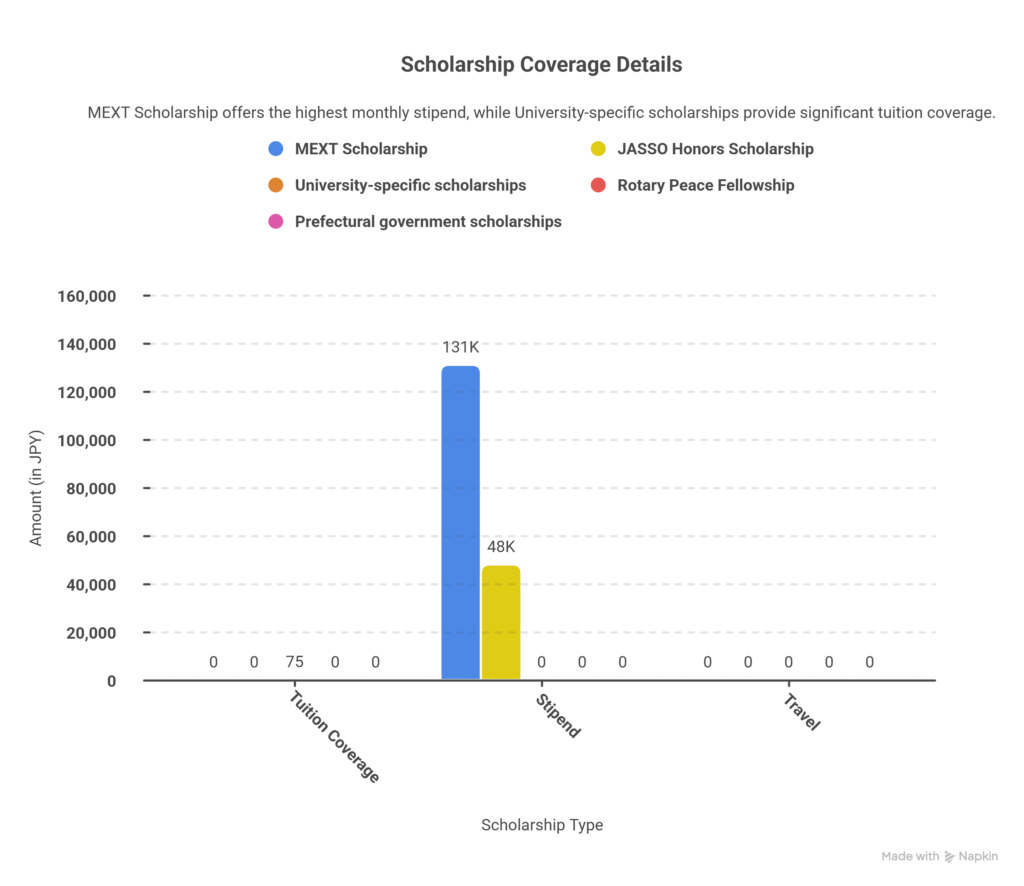
Japan offers some of the most generous scholarship programs in Asia. The MEXT (Ministry of Education, Culture, Sports, Science and Technology) scholarship is the most well-known and covers full tuition, a monthly stipend, and round-trip airfare. Applications are typically processed through Japanese embassies in your home country or directly through universities.
Beyond MEXT, several institutions and prefectural governments offer their own scholarship programs. Many of these do not require Japanese language proficiency, especially for English-medium postgraduate programs.
International students in Japan are permitted to work part-time with a work permit, which is obtained by filing a Permission to Engage in Activity Other Than That Permitted Under the Status of Residence at the local immigration office. This is typically handled during or shortly after your initial entry into Japan.
The legal limit is 28 hours per week during term time and up to 8 hours per day during official school breaks. Common part-time roles include convenience store staff, restaurant worker, language tutor, and campus part-time roles. Hourly wages range between 1,000 and 1,500 JPY depending on the city and role.
Living in Japan as a student is a genuinely rewarding experience. Major university cities like Tokyo, Kyoto, Osaka, and Sendai offer a mix of modern infrastructure and historic culture. Campus life is active, with hundreds of student clubs, cultural events, and academic conferences held throughout the year.
Most universities provide dormitory options for international students, particularly in the first year. Monthly costs for on-campus housing range from 15,000 to 40,000 JPY, which is significantly lower than off-campus private apartments in major cities. Student discounts are widely available on transport, food, and cultural activities.
For programs taught in Japanese, you will need to demonstrate proficiency through the JLPT examination. N2 is generally the minimum required for undergraduate study, while some graduate programs accept N3 with additional support. For English-taught programs, Japanese language skill is not mandatory at the time of admission.
That said, learning basic Japanese significantly improves your day-to-day experience in Japan, especially for those living outside major urban centers. Many universities offer free or subsidized Japanese language courses for international students from the moment they arrive on campus.
Planning your application timeline early prevents last-minute complications. Japanese universities typically have two main intake periods: April (spring) and October (autumn). The April intake is the most common, and applications often open in the preceding September or October.
For the most accurate and up-to-date information on studying in Japan, the following official sources are recommended.
Japan Student Services Organization (JASSO): www.jasso.go.jp/en – Official resource for student support, scholarships, and statistical data.
MEXT Scholarship Information: MEXT Official Page – Full details on government-funded scholarship programs for international applicants.
Studying in Japan in 2026 is a decision that combines academic excellence, cultural immersion, and long-term career value. The country offers a structured pathway from application to graduation, with strong institutional support for international students at every stage.
The key is to start early. Research your university options thoroughly, connect with potential supervisors if you are pursuing graduate study, prepare your language credentials, and begin your visa paperwork well before your intended intake date. With proper planning, the path to studying in Japan is entirely manageable and deeply rewarding.
For students seeking an education that combines rigorous academics with a life-changing personal experience, Japan remains one of the strongest choices available in 2026.




Not a member yet? Register now
Are you a member? Login now