No products in the cart.


Do you want to improve your IELTS score quickly? You’ve come to the correct spot. Ten tried-and-true methods are broken down in this tutorial to help you raise your band score in each of the four sections: speaking, writing, listening, and reading. You’ll find useful advice catered to your needs, regardless of your level of experience. To help you remain on track and achieve significant progress, we’ve also included a straightforward 30-day study plan with a daily schedule. Along the road, you’ll come across helpful tools from reliable sources like the British Council, IDP, and IELTS as well as typical blunders to steer clear of. To help you stay motivated and advance more quickly, everything is explained in an understandable and straightforward manner. Follow these practical, motivational steps – with examples from official sources and expert coaches – to boost your IELTS score efficiently.
All IELTS applicants should use these pointers. While intermediate students concentrate on improving speed and accuracy, advanced students hone their fluency and coherence, while beginners should concentrate on essential skills (basic grammar, vocabulary, and comprehension of the test format). For instance, one-month IELTS study schedules suggest studying for one to two hours every day; lower-level students frequently require more review time. Advanced students may spend time honing their vocabulary and taking comprehensive practice exams. The key to success lies in tailoring your approach: senior pupils identify and rectify minor errors, while beginners establish a solid foundation.
Be fully aware of the contents of the IELTS exam. Examine the format and duration of each section: Speaking (11–14 minutes), Writing (60 minutes), Reading (60 minutes), and listening (30 minutes). Learn about band scoring and tasks; for example, writing task 2 is given more weight than task 1. Download and go over the official band descriptions for speaking and writing to understand what examiners look for (pronunciation, task response, coherence, vocabulary, and grammar). Knowing the exam’s “blueprint” allows you to set priorities. For example, practice writing essays extensively because they have a significant impact on your score. Use the early study days to go over sample questions and forms because familiarity develops confidence.
Use the official IELTS study materials. To experience actual exam content, take practice exams on the British Council, IDP, and IELTS.org websites. Regularly take full-length practice exams once a week. Exam conditions should be simulated (tight timing, no stops). Examine each practice critically, looking for incorrect answers, figuring out why you missed them, and taking note of your faults. To find your areas of weakness, keep track of your scores in each skill. To find out exactly what has to be improved, if at all feasible, seek feedback on your speaking and writing (e.g., via IELTS Writing Assist or paid essay marking). Steady progress, not perfection, is the aim. Official practice gradually increases familiarity and identifies areas where you need to improve.
Every segment benefits from a broad vocabulary. To learn new words in context, read a lot of books, blogs, and news articles. Maintain a vocabulary notebook. Write down new words, particularly synonyms and idioms, and incorporate them into your own statements. High-frequency IELTS terms can be practiced with the aid of apps like Quizlet and the IELTS Prep App. Try to employ both common and uncommon terminology in your writing and speech. Practice paraphrase for reading and listening by matching questions’ keywords to synonyms in the text or audio. For instance, be aware to listen or read for “rise” or “grow” if a question involves the word “increase.” Strong vocabulary increases your lexical resource score in writing/speaking in addition to improving accuracy in reading/listening replies.
Take an active approach to listening. Use the example given before each section to acclimate your ears to the accents of the speakers. As you listen, highlight important terms in the questions and make predictions about the responses. Just concentrate on the details for each question; they adhere to the sequence of the recording. Keep an eye out for distractions: speakers frequently highlight an incorrect response before giving the right one. Listen for context rather than attempting to translate or comprehend every word in real time. Replay the transcript after practice recordings to make sure you don’t miss anything. Lastly, practice transferring answers neatly while the test is on paper, paying close attention to plurals and spellings. You can learn to choose keywords and increase accuracy under time constraints with regular practice (e.g., daily podcasts or IELTS listening examinations).
In the Reading part, employ time-saving strategies. To understand the primary idea of each passage, first skim it by reading the title and the first few lines. Determine the topic sentences-typically the opening sentence of each paragraph-and mentally highlight them. Next, look for answers: when you come across a question, make a note of its keywords and look for synonyms in the text. Keep in mind that you don’t have to comprehend every word; you can use context to deduce meaning and omit terms you don’t understand. Always read the directions; for instance, if it states “no more than three words,” don’t write more (otherwise you’ll lose points). Work methodically: respond to the questions in the sequence that the passage specifies. To increase speed, practice passages under timed conditions on a regular basis. Scanning and skimming become second nature with time, increasing your confidence and accuracy.
Planning each activity will help you write effectively. For both writing assignments, always take a few minutes to outline your response. Write a thesis and two major points in Task 2 (essay); make a list of the important bullet points in Task 1 (letter or report). Since Task 2 receives a higher score, adhere to the suggested time split of 20 minutes for Task 1 and 40 minutes for Task 2. For every paragraph, use distinct topic sentences and a range of linking words (such as “furthermore,” “however,” and “moreover”) to connect concepts. After writing, spend a couple of minutes proofreading: correct any spelling, grammar, or punctuation mistakes. Ensure you’ve addressed all parts of the task and met word counts (150 for Task 1, 250 for Task 2) to avoid penalties. Practicing this plan–write–review cycle will steadily improve your coherence and cohesion scores on test day.
Speaking exercises on a daily basis are revolutionary. Record yourself responding to Part 1 questions (about yourself) and Part 2 prompts (one to two minute monologues) to simulate the test. Aim for fluidity by answering succinctly (never just “yes” or “no”) and continuing to speak without extended pauses. Use a variety of syntax and vocabulary, paraphrasing as necessary. Keep your pace and pronunciation right, speak clearly, and listen back to make necessary corrections. Don’t forget to speak directly to the examiner rather than the recorder. Use the official Speaking Band Descriptors: aim to demonstrate a broad vocabulary and complex sentences. Finally, treat Speaking like a conversation. Stay relaxed and “friendly” to engage the examiner, which can help you forget the pressure of being tested. The more you speak (with tutors, friends, or apps), the more natural and fluent you’ll become.
Prepare for an exam. Make sure that each section’s time is rigorously adhered to during practice. For instance, a reading test takes 60 minutes to complete; don’t fool yourself by going overboard. If necessary, set alarms. Incorporate brief pauses that resemble the actual exam, such as one in between the listening sections. Incorporate activities: as many excellent programs advise, dedicate one day to listening practice, another to reading, etc. To increase stamina, complete full-length tests (listening, reading, and writing in a single session) during the final two weeks of your plan. Mark everything and quickly review any problems after each session. Your test day will be predictable and comfortable thanks to this structured regimen. According to IDP, the secret to advancement is regular practice and knowing precisely what needs to be improved.
Every error should be viewed as a teaching opportunity. Maintain an error journal in which you record incorrect responses or poorly written essays and study the reasons behind them (e.g., misinterpreted question, grammatical error, vocabulary gap). Review this log frequently to prevent making the same mistakes twice. In order to transform writing problems into strengths, the British Council even recommends keeping a learning notebook. Learn about typical IELTS pitfalls as well, such as not carefully transferring answers in listening/reading, using an informal tone in official writing, giving incomplete answers when speaking, or failing to follow word count rules. For these areas of weakness, perform specific activities (e.g., spelling drills, linking phrases, and practice under-pressure replies). You’ll gradually improve your band in every segment by actively fixing your mistakes.
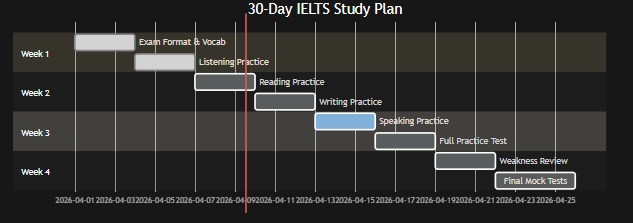
Commit to a structured 30-day schedule. A focused plan keeps you on track and motivated. For example, one month plan divides days among tasks: early days cover test format and vocabulary; mid-weeks emphasize Listening and Reading drills; later days focus on Writing/Speaking practice and mock tests. Use the tables below as a blueprint. Stick to it, but adjust for your level: beginners may spend extra time on basics, advanced learners can do extra practice tests. Schedule one rest day each week to recharge (as recommended in study guides). Following this roadmap will steadily build your skills and confidence until test day.
▪ Week 1: Learn exam format and key vocabulary, start daily Listening drills.
▪ Week 2: Practice Reading techniques and Writing tasks (essay/letter planning).
▪ Week 3: Daily Speaking practice and one full practice test.
▪ Week 4: Target weak areas identified from practice tests, then take 1–2 final full mocks.
| Days | Focus Area | Actions |
|---|---|---|
| 1–3 | Exam Overview | Review IELTS structure, band criteria, sample questions. Start a vocabulary list. |
| 4–6 | Listening | Do Listening exercises; use transcripts for error analysis. |
| 7–9 | Reading | Practice skimming/scanning on passages; note unfamiliar words. |
| 10–12 | Writing | Outline and write one Task 1 and one Task 2 answer. Get feedback. |
| 13–15 | Speaking | Answer speaking prompts on recording; focus on fluency. |
| 16–17 | Review & Test | Take a short Listening + Reading test; review all mistakes. |
| 18–21 | Skill Drills | Rotating focus: grammar & vocab apps, mock speaking, etc. |
| 22–24 | Full Practice Tests | Take full Listening, Reading, Writing tests under timed conditions. |
| 25–27 | Weaknesses | Focus on weak areas like grammar, note-taking, complex sentences. |
| 28–29 | Final Review | Revise notes, vocabulary, and strategies. Keep practice light. |
| 30 | Mock Test & Relax | Take one final mock test in the morning; relax and prepare mentally. |
This intensive but balanced plan (suggested by expert guides) ensures daily progress. Adjust timing as needed: for instance, Magoosh advises 1–2 hours per day, with more time for lower levels. The consistent routine builds skill without burnout.
| Time | Activity |
|---|---|
| 6:30–7:00 AM | Read an English news/article (build vocabulary and reading speed) |
| 7:00–7:45 AM | Listening practice: podcasts or IELTS clips (note keywords) |
| 7:45–8:00 AM | Quick review of new vocabulary |
| 9:00–10:00 AM | Writing practice: outline and write one essay or letter |
| 10:00–10:15 AM | Break (short walk or relax) |
| 10:15–11:00 AM | Grammar/vocabulary exercises (app or workbook) |
| 11:00–11:30 AM | Speaking: answer 2–3 cue-card questions aloud; record and self-critique |
| 12:00–12:45 PM | Lunch break and rest |
| 1:00–2:00 PM | Reading practice: one timed IELTS passage; review answers |
| 2:15–3:00 PM | Review errors from earlier sessions; update notes |
| Evening | Light English exposure (movie, TV show, or conversation) |
It takes more than just studying harder to get a high IELTS score; you also need to study more intelligently. You can greatly enhance your performance in a short amount of time by applying the appropriate techniques, being consistent, and concentrating on your areas of weakness. The secret is to practice frequently, evaluate your errors, and keep improving your speaking, listening, reading, and writing abilities. Recall that achieving success on the IELTS takes time. Remain disciplined, patient, and have faith in the process. You can achieve your desired band score if you have the correct attitude and a well-thought-out plan. Start today, stay committed, and take one step closer to your dream of studying or working abroad
It depends on your current English level, but most students need around 4 to 8 weeks of focused preparation.
Yes, with proper planning, online resources, and regular practice, you can achieve 7+ or even 8+.
Practice daily, focus on weak areas, take mock tests, and review mistakes carefully.





Not a member yet? Register now
Are you a member? Login now