No products in the cart.


As an IELTS coach who has worked with hundreds of candidates over the past decade, I have seen the Speaking section cause the most anxiety. The test evaluates your ability to communicate naturally and effectively in just 11–14 minutes. High scores are essential for university admissions, skilled migration, or professional registration in countries like Australia, Canada, and the UK. Global average Speaking scores typically hover around 6.0, with Writing often lower at about 5.6. This gap shows that targeted, intelligent preparation can make a real difference.
The four assessment criteria fluency and coherence, lexical resource, grammatical range and accuracy, and pronunciation each account for 25% of your band. Success comes from developing authentic spoken English rather than memorizing answers. In this guide, I share battle-tested strategies based on what actually works in real exams and coaching sessions.
The test is divided into three parts.
Examiners use public band descriptors to score performance. For band 7, you need fluent speech with only occasional hesitation, a good range of vocabulary and structures, and clear pronunciation. Band 8 requires effortless fluency, wide and precise vocabulary, flexible grammar, and natural intonation with minimal accent interference.
Recent data confirms Speaking averages remain near 6.0 globally, though some sources report slight improvements in certain regions. In high-volume countries like India and China, averages often sit between 5.8 and 6.2, underscoring the value of focused practice to push toward 7.0 or above.
Before applying any IELTS Speaking strategies, you must understand how examiners evaluate performance.
| Assessment Criteria | Weightage | Examiner Expectation |
| Fluency and Coherence | 25% | Smooth flow, logical ideas |
| Lexical Resource | 25% | Vocabs range and accuracy |
| Grammatical Range | 25% | Sentence variety, correctness |
| Pronunciation | 25% | Clarity, stress, intonation |
In my classroom observations, most candidates lose marks in fluency and coherence. They pause too often or struggle to organize ideas.
Your preparation should match this scoring structure.
Expand every answer thoughtfully. One-word or very short replies cap your potential. Always add reasons, examples, or personal details.
For the question: Do you enjoy reading books? Respond with – Yes, I really enjoy reading because it helps me relax after a long day. For example, I recently finished a novel by Haruki Murakami, and the story taught me new perspectives on life and relationships.”
Record yourself regularly. Use your phone to answer sample questions, then listen critically. Note hesitations, repetitions, filler words, and pace. Aim for 120–150 words per minute, natural yet controlled.
Develop topic vocabulary systematically. Common IELTS themes include education, technology, environment, health, travel, and work.
Learn 8–10 high-value items per topic weekly collocations. Vary grammar structures. Combine simple, compound, and complex sentences. Use conditionals (“If governments invested more in public transport, traffic congestion would decrease”), passives (“Many products are manufactured overseas”), and relative clauses (“Students who study abroad often become more independent”).
Prioritize pronunciation. Focus on word stress, sentence stress, intonation for questions/opinions, and linking (“I have to” → “I hafta”). Shadowing, repeating after native speakers from podcasts or YouTube builds rhythm and reduces mother-tongue influence.
In Part 2, maximize the one-minute preparation. Jot quick notes: main idea, two supporting points, personal example, conclusion. This structure prevents rambling. One student improved from 6.0 to 7.5 by always ending with a reflective sentence like “Overall, that experience taught me the value of perseverance.”
Replace fillers (“um,” “like,” “you know”) with natural bridges: “That’s a good question,” “Let me think for a second,” or “Interestingly.” This maintains fluency and impresses examiners.
In Part 3, show balanced opinions. For “Does technology make life easier?”, say: “Technology certainly makes many tasks more convenient, such as online banking and instant communication. However, it can also lead to distractions and reduced face-to-face interaction, so moderation is important.”
Studies and coaching feedback show that 70 – 80% of band 7+ candidates practice with partners or tutors to simulate the interactive format. Mock interviews reveal nerves, timing issues, and off-topic drifts early.
Nerves cause rushed speech, making pronunciation unclear. Practice slow, deliberate delivery first, then speed up gradually. Deep breathing before starting calms you. Memorized scripts sound robotic. Examiners penalize lack of spontaneity. Build idea banks instead: key points and flexible phrases per topic.
Stay on topic. If lost, paraphrase: “If I understand correctly, you’re asking about the influence of social media on young people?” This buys time and shows comprehension.
Avoid vocabulary repetition. Replace repeated “good” with “advantageous,” “rewarding,” “beneficial,” or “valuable.” This directly lifts lexical resource.
Limit long pauses. Top performers keep speech flowing with under 5% hesitation time. Use fillers strategically rather than silence.
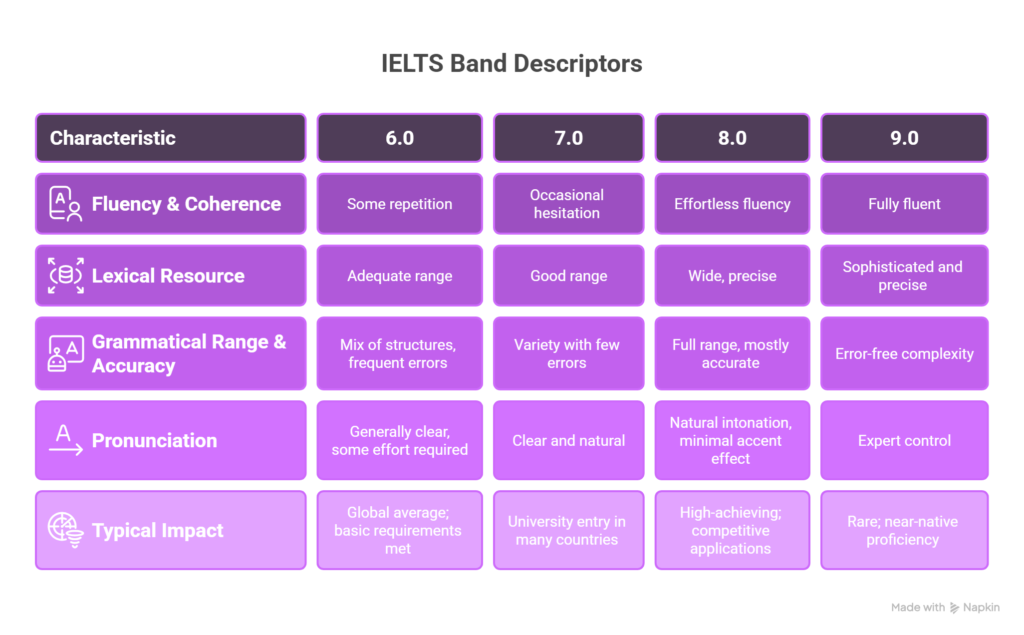
Target your weak areas using this table as a roadmap.
Consistency beats intensity. Follow this realistic schedule:
Journal progress: “Fluency stronger this week; still need more idioms.”
Official sites (GlobalEd, British Council, IDP ) provide free cue cards and samples. Cambridge IELTS books offer authentic tasks. Apps like ELSA Speak analyze pronunciation. Podcasts (“6 Minute English,” “Luke’s English Podcast”) build listening-speaking connections.
High IELTS Speaking scores come from daily, deliberate practice focused on natural communication. Expand answers, vary language, reduce errors, and simulate real tests. Students following these strategies routinely reach band 7.0 – 8.0. Treat the examiner as a friendly conversation partner, not a judge. Stay consistent, seek feedback, and trust the process.
Read our related blogs : IELTS Band Score Requirements for Study, Work and Immigration




Not a member yet? Register now
Are you a member? Login now