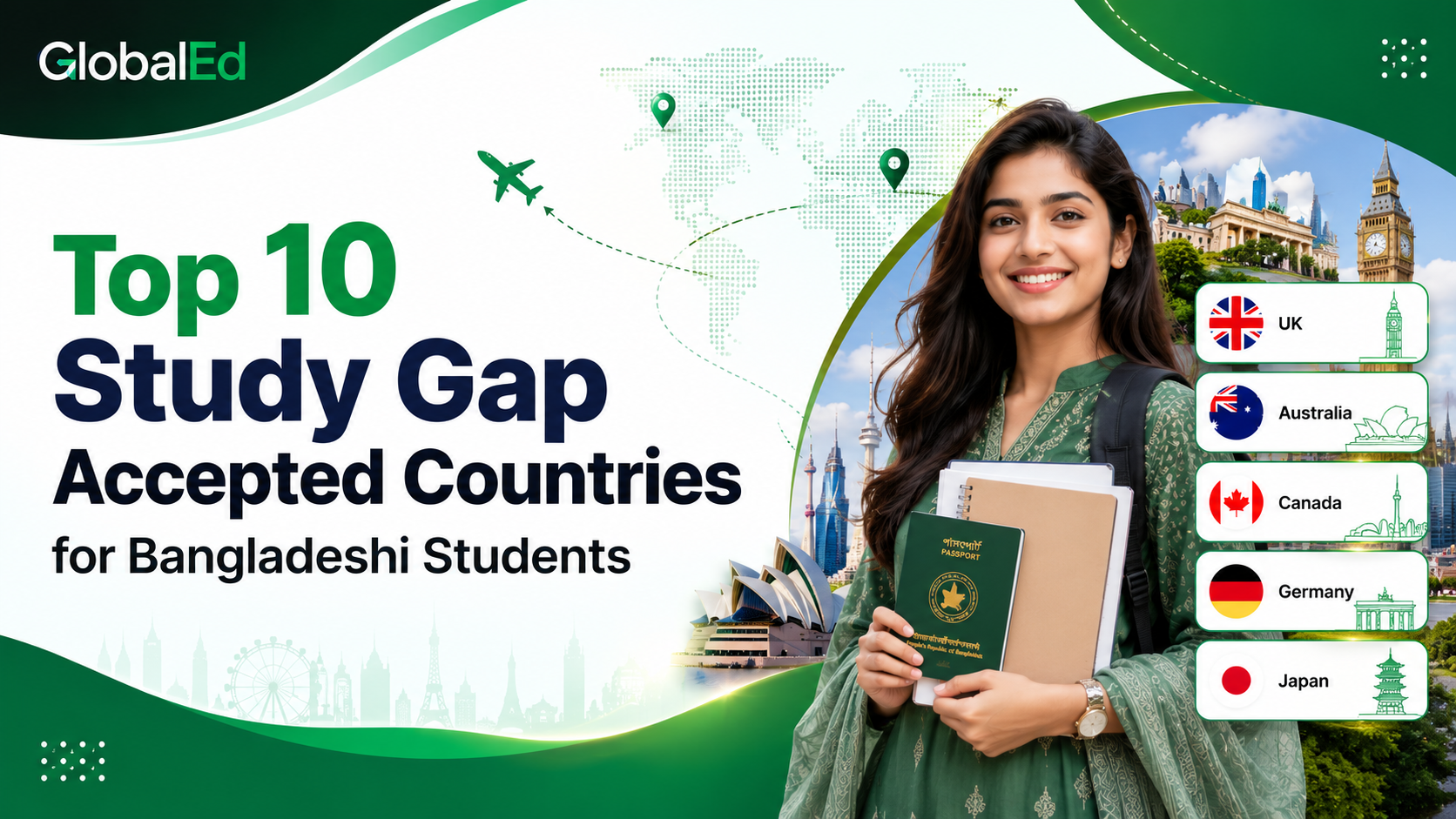
Many Bangladeshi students dream of studying abroad. However, one common concern often creates uncertainty: study gap. Now we will discuss about top 10 Study Gap Accepted Countries for Bangladeshi Students.
Whether you took a break after HSC, completed your bachelor’s degree a few years ago, or spent time working before applying, a study gap does not automatically prevent you from studying overseas.
In fact, several countries actively accept international students with study gaps, provided they can explain their academic and professional journey properly.
In this guide, we will explore the top 10 study gap accepted countries for Bangladeshi students in 2026, their study gap policies, and how you can strengthen your application.
Table of Contents
What Is a Study Gap?
A study gap refers to the period between your previous academic qualification and your next educational application.
For example:
- HSC completed in 2020 and university application in 2026
- Bachelor’s completed in 2019 and Master’s application in 2026
Study gaps may occur due to:
Fortunately, many universities understand these situations.
Does Study Gap Affect Study Abroad Applications?
Yes, but not always negatively.
Most universities and visa officers focus on:
- Why the gap occurred
- How you utilized the gap period
- Whether your future study plan makes sense
- Supporting documents and evidence
Therefore, a well-explained study gap often receives positive consideration.
2026 Guide: 10 Countries That Accept Study Gaps for Bangladeshi Students
1. United Kingdom (UK)
The UK remains one of the most popular destinations for Bangladeshi students.
Typical Study Gap Acceptance
- Undergraduate: 2-5 years
- Postgraduate: 5-10+ years
Many UK universities accept mature students with professional experience.
Why Choose the UK?
- Globally recognized degrees
- One-year master’s programs
- Post-study work opportunities
- Large Bangladeshi student community
2. Australia
Australia is known for its flexible admission policies.
Typical Study Gap Acceptance
- Undergraduate: Up to 3-5 years
- Postgraduate: Up to 8-10 years
Work experience significantly strengthens applications.
Benefits
- High-quality education
- Graduate work opportunities
- Strong international student support
3. Canada
Canada continues to attract thousands of international students annually.
Typical Study Gap Acceptance
- Undergraduate: 2-5 years
- Postgraduate: 5-8 years
Applicants must clearly justify longer gaps.
Benefits
- Affordable education options
- Work while studying
- Immigration pathways
4. Germany
Germany offers excellent opportunities, especially for STEM students.
Typical Study Gap Acceptance
- Often accepts 5-7 years or more
- Strong focus on academic relevance
Benefits
- Low or no tuition fees in many public universities
- High employability
- Strong engineering programs
5. Sweden
Sweden values professional experience and lifelong learning.
Typical Study Gap Acceptance
- Frequently accepts 5+ years
- Relevant work experience is highly appreciated
Benefits
- Innovation-focused education
- Research opportunities
- International learning environment
6. Denmark
Denmark has become increasingly attractive for international students.
Typical Study Gap Acceptance
Benefits
- Industry-oriented education
- High quality of life
- English-taught programs
7. Ireland
Ireland’s growing education sector offers flexible admission options.
Typical Study Gap Acceptance
- Up to 5-8 years for many postgraduate programs
Benefits
- Strong job market
- English-speaking environment
- Technology and business-focused courses
8. New Zealand
New Zealand is often considered a student-friendly destination.
Typical Study Gap Acceptance
- Up to 5-10 years depending on profile
Benefits
- Safe environment
- Quality education
- Flexible study options
9. Malaysia
Malaysia remains one of the most affordable study destinations.
Typical Study Gap Acceptance
- Often accepts significant study gaps
Benefits
- Affordable tuition fees
- Lower living costs
- International campuses
10. Japan
Japan has become increasingly popular among Bangladeshi students.
Typical Study Gap Acceptance
- Frequently accepts 5-10 years with proper explanation
Benefits
- Growing scholarship opportunities
- Advanced technology sector
- Career opportunities after graduation
Employment Experience
If you worked during the gap period, provide:
- Employment certificates
- Salary records
- Experience letters
Business Activities
Provide:
- Trade license
- Business registration
- Tax-related documents
Professional Development
Include:
Personal Circumstances
If the gap occurred due to family or health reasons, provide supporting evidence whenever possible.
Documents Required for Students With Study Gap
Before applying, prepare:
- Academic transcripts
- Certificates
- Updated CV
- Statement of Purpose (SOP)
- Experience letters
- IELTS score (if required)
- Passport
- Financial documents
Common Mistakes to Avoid
Hiding the Gap
Never attempt to conceal your study gap.
Submitting Unsupported Claims
Always provide evidence for employment or activities.
Weak Statement of Purpose
A strong SOP should clearly explain:
- Why the gap happened
- What you learned
- Why you want to study now
Proper guidance can significantly improve application quality.
A study gap should not stop you from pursuing higher education abroad.
Today, many universities in the UK, Australia, Canada, Germany, Sweden, Denmark, Ireland, New Zealand, Malaysia, and Japan evaluate applicants holistically. As long as you can explain your study gap honestly and provide supporting documents, you may still have strong opportunities to study overseas.
Instead of focusing on the gap itself, focus on building a clear academic and career pathway. With proper planning, documentation, and guidance, studying abroad in 2026 remains achievable for many Bangladeshi students.
Top 10 Study Gap Accepted Countries for Bangladeshi Students in 2026
Countries such as the UK, Australia, Germany, Japan, and New Zealand often accept longer study gaps when applicants provide strong justification and relevant documentation.
Yes. Many universities worldwide accept students with a 5-year study gap, especially for postgraduate programs.
In some cases, yes. Professional work experience, business activities, and a strong academic purpose can support applications with longer study gaps.
ELTS itself does not remove a study gap, but a strong IELTS score demonstrates readiness for academic study and strengthens the overall application.
The UK, Australia, Canada, Germany, and Japan are among the most popular destinations due to their relatively flexible study gap policies and strong education systems.
Yes. Relevant work experience is one of the strongest factors that can positively support a study gap explanation.